
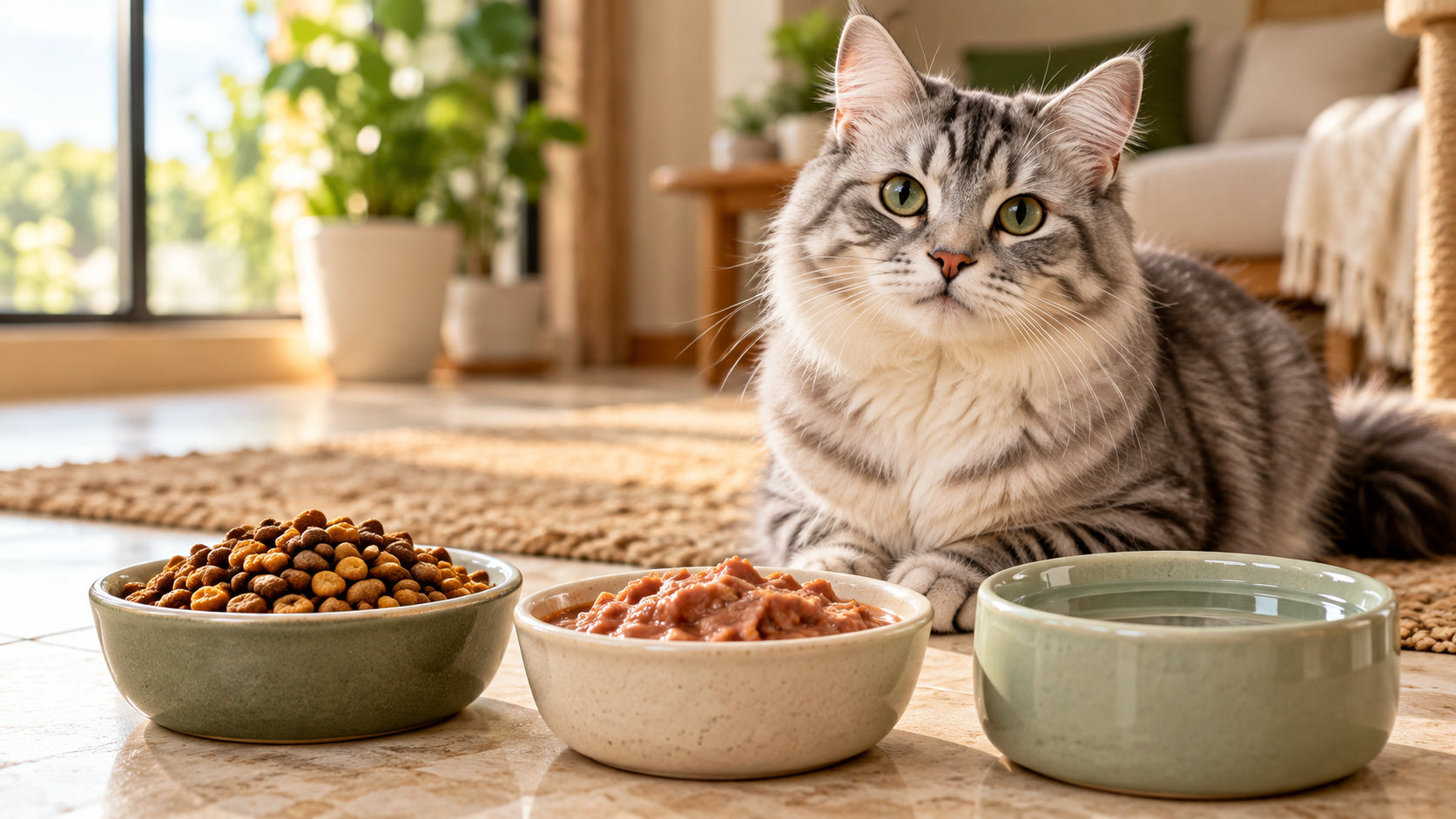

Choosing cat food is easier when you start with the cat rather than the packaging. Words like "premium", "natural" and "gourmet" say very little about whether a food suits her. Her age, health, weight and daily routine matter far more.
This guide explains how to choose cat food in Pakistan in practical terms. It covers how to read a label, how kittens differ from adults, whether wet or dry suits you better, how much to feed, which household foods are safe, and how to keep food from spoiling in summer.
Disclosure
Pet Panda sells cat food and related pet products, and this article may link to relevant Pet Panda collections or products. The information is provided for general educational purposes and is not a substitute for advice, diagnosis, or treatment from a qualified veterinarian. Product availability, prices, and formulations may change over time.
The short version
Pick a food made for your cat's life stage, and check that it is meant to be a complete diet rather than a topper or snack. Wet and dry food can both work. Use the feeding guide on the pack as a starting point and adjust by watching your cat's weight. Store food properly, and speak to a vet if your cat has a health condition or something seems wrong.
Why cats can't just eat what dogs eat
Cats are obligate carnivores, which means their bodies depend on nutrients found in animal tissue. Three important nutrients to understand are taurine, vitamin A and arachidonic acid.
Taurine is an amino acid that cats must get from their food. Long-term shortage can damage the heart and eyes. Vitamin A also has to come ready-made, because cats can't convert beta-carotene from plant sources like carrots into it. Arachidonic acid is a fatty acid that cats need from their diet as well.
You don't need to calculate any of this. A complete cat food is formulated to cover these needs together, which is also why a high number for one nutrient on a label doesn't prove the food is good. What matters is whether the whole recipe is balanced.
It is also why dog food isn't a suitable everyday diet for a cat. It isn't designed around these needs. If your cat steals a few bites from the dog's bowl, that is not an emergency, but it shouldn't become routine. If you share your home with both, our dog food guide covers how to choose and feed dog food.
Sources: Merck Veterinary Manual, Nutritional Requirements of Small Animals; Merck, Proper Nutrition for Cats.
How to read a cat food label
Start with who the food is for. It should name cats, and ideally your cat's stage of life, such as kitten, adult, or all life stages.
Next, look for the word "complete". A complete food is intended to be fed on its own. Foods described as complementary or supplemental are not, and neither are most treats. This matters most with wet food, because a pouch of chunks in gravy can look like a proper meal and still be meant only as an extra.
Many imported foods carry a nutritional adequacy statement, which says the recipe is complete and balanced for a certain life stage. "Complete" means the food contains all the nutrients cats are required to get, and "balanced" means they are present in the right proportions. Many of these statements follow wording set out by AAFCO, a US organization. That framework is not Pakistani law, and not every label will use it, so don't treat the absence of AAFCO wording as a warning or its presence as a guarantee. FEDIAF in Europe publishes its own nutritional guidelines, and WSAVA has a global guide for choosing pet food.
The ingredient list is worth reading, but it is a weak guide to quality. It doesn't show how digestible the food is or whether the nutrients are balanced. Use it as one clue among several.
Finally, check the feeding guide, calorie information if given, storage directions, and pack size. A big bag only saves money if your cat finishes it before it goes stale. To see which brands Pet Panda stocks, browse its cat food brand directory, then compare their labels using the steps above.

Sources: AAFCO, Reading Labels; WSAVA Global Nutrition Guidelines; FEDIAF Nutritional Guidelines.
Choosing food by life stage
Age groups are useful guides, but cats don't all age on the same timetable.
Kittens
Kittens grow quickly and need a food made for growth. They also do better on several small meals a day than on one or two big ones. Merck's owner guide suggests three to four meals a day for kittens under about four months old, with fewer meals as they grow. Cornell describes it by age: about three meals a day until six months, then usually two a day until about a year. The two sources differ a little, and the right pattern also depends on your kitten's health and the food she eats, so treat these as general guides rather than a fixed schedule.
Merck advises that kittens keep eating kitten food until they reach adulthood, at about 9 to 12 months. Start with the feeding guide on the pack, and ask your vet when to move your kitten to adult food, especially if she is small for her age or has a health problem. Pet Panda's kitten collection has a small selection, including Bonacibo Kitten, and more kitten foods appear in the wider cat food range. Read the label of any kitten food you consider.
Adult cats
Adult cats do well on a complete adult or all-life-stages food, with portions matched to their weight and body condition.
Senior cats
Senior cats don't automatically need a "senior" formula, and the word on the bag isn't a guarantee that a food suits your cat. Her health and body condition matter more, and life-stage guidelines treat age groups as a starting point because individual cats vary. Weight loss, a weaker appetite, or changes in drinking or urination in an older cat are reasons to see a vet, not just to switch brands.
Pregnant and nursing cats
Pregnant and nursing cats have higher nutritional needs than an adult cat at maintenance. Some labels carry an adequacy statement for growth and reproduction, or for gestation and lactation, and others say the food suits all life stages. Check which stages the label covers, and ask your vet what suits her.
Neutered or sterilized cats
Neutered cats often need less energy than before and can put on weight more easily. Watch her weight and adjust portions. Some owners choose a food made for sterilized cats, such as Royal Canin Sterilised 37. Check the label for yourself, and see a vet for any urinary or other medical concerns.
Sources: AAHA/AAFP Feline Life Stage Guidelines; Merck Veterinary Manual, Nutritional Requirements of Small Animals (energy needs of neutered cats); Merck, Proper Nutrition for Cats (kitten feeding and kitten food); Cornell, How Often Should You Feed Your Cat? (kitten meal frequency).
Wet food or dry food
Either can be a good choice, as long as it is complete and your cat does well on it. The practical differences are below.

| Feature | Wet food | Dry food |
|---|---|---|
| Moisture | High, so it adds to water intake | Low |
| Convenience | Needs opening; leftovers need extra care | Easy to store and measure |
| Storage | Unopened: store in a cool, dry place. After opening: refrigerate leftovers promptly or discard them, following the packaging instructions. | Keep sealed, cool and dry |
| Routine | Suits set mealtimes | Easy to measure, but leaving it out makes intake hard to track |
| Completeness | Check the label, as some are complementary | Check the label |
| Cost | Price per 100 g can be misleading because wet food contains more water. Compare the cost of feeding the recommended daily portion, and check that the food is complete. | Compare the cost of the recommended daily portion, not just the price per bag. Make sure the food is complete for your cat's life stage. |
Many owners feed both. If you do, count both toward the day's total, because it is easy to overfeed when the dry food bowl is topped up on top of a wet meal. A pouch such as Whiskas Adult Chicken in Jelly is an example of the format. Check the label to see whether any wet food you buy is complete or complementary.
Whichever you pick, keep clean water available.
Source: Cornell Feline Health Center, Feeding Your Cat.
How much and how often to feed
No single amount suits every cat. The right portion depends on her age, weight and body condition, how active she is, whether she is neutered, any health conditions, and how many calories are in the food.
Start with the feeding guide on the pack, then watch what happens. Weigh her regularly and check her body shape. The WSAVA body condition score chart for cats shows how to tell whether a cat is underweight, about right or overweight. If she is gaining or losing, adjust gradually. If you are unsure, ask a vet.
Cornell suggests one or two measured meals a day for most adult cats, with smaller, more frequent meals for kittens. Treats should stay limited. WSAVA's guide for cat owners says treats should make up less than 10 percent of a cat's daily calories and should never replace a meal, because every cat needs a complete and balanced diet. Ask your vet how much and what kind of treat suits your cat.
Sources: Cornell, How Often Should You Feed Your Cat?; Cornell, Feeding Your Cat; WSAVA, Feeding treats to your cat.
Milk, roti, rice and chicken
These are the questions owners ask most, so here are straight answers.
Many cats can't digest milk well, and it can upset their stomachs. Cats don't need it. Plain water is what they need.
Plain, unseasoned cooked chicken is often given as a small occasional extra, but it isn't a complete long-term diet, and Merck advises avoiding table scraps in general. Rice and roti are the same, because they don't supply what a cat needs. Leftover curry or masala dishes can contain onion, garlic and a lot of salt, which aren't suitable for cats, and the ASPCA names onion and garlic as a particular risk for cats. Tuna made for people shouldn't become her only food either, because Cornell notes that some cats fed canned fish made for people have developed serious neurological problems.
If your cat eats something unusual, check what it was. If it may be toxic, contact a vet promptly rather than waiting for symptoms.
Sources: ASPCA, People Foods to Avoid Feeding Your Pets; Merck, Proper Nutrition for Cats; Cornell, Feeding Your Cat.
Homemade and raw diets
Home cooking sounds like the safest option, but it is hard to get right. A cat's diet has to be balanced across many nutrients, and meat alone isn't enough. Without a properly formulated recipe, a homemade diet can end up missing important nutrients. That is why this guide doesn't include a recipe. If you want to cook for your cat, work with a veterinarian or a qualified veterinary nutritionist.
Raw diets carry a separate problem. In an FDA study of commercial pet food, raw products were more likely than other types to be contaminated with bacteria such as Salmonella and Listeria, which can affect pets and the people who handle the food. The ASPCA also notes that raw meat and raw eggs can carry bacteria such as Salmonella and E. coli. Raw feeding is not inherently healthier: Cornell says scientific evidence of benefit is lacking and does not recommend raw diets for cats.
Sources: Merck, Proper Nutrition for Cats; FDA, Raw Pet Food Diets Can Be Dangerous to You and Your Pet; Cornell, Feeding Your Cat; ASPCA, People Foods to Avoid Feeding Your Pets.
Storing cat food in hot weather
Summer heat is the main storage problem here, and most of the fixes are simple.
Keep dry food in its original bag, since that has the batch information and storage directions. If you want extra protection, put the whole bag inside a clean, dry container with a lid. If you would rather pour the food into a container, keep the original bag or note down the product name, lot number and "best by" date, so you can check for a recall if one is ever announced. Store it in the coolest, driest spot you can manage, away from sun and damp, and follow the manufacturer's instructions.
Once a can or pouch of wet food is opened, refrigerate what is left promptly, or throw it out, as the packaging instructs. The FDA advises keeping the refrigerator at 40°F (4°C) or below. Don't leave wet food sitting out longer than necessary. The FDA says to refrigerate or discard leftovers promptly rather than giving a set number of hours at room temperature, so the label is your guide. Wash food bowls and scoops after each use, and wash the water bowl daily. Before you feed, check the pack. Damaged packaging, a foul smell, or a swollen or leaking can or pouch are all reasons not to feed it, and the FDA lists the last two as product problems that owners should report.

The FDA advises keeping dry and unopened canned food below 80°F, about 27°C. That is US guidance rather than a Pakistani standard, and it doesn't promise that food stays safe at any particular temperature. In a very hot home, smaller packs may help you finish the food while it is fresh.
Source: FDA, Proper Storage of Pet Food and Treats.
Switching to a new food
Change food gradually and watch how she responds, since cats react differently. There is no single schedule that suits every cat. Offer a little of the new food alongside the old, and let her appetite and digestion guide the pace. If she has a medical condition, or develops digestive problems that don't settle, speak to your vet.
Foods and plants that can harm cats
These dangers are not all equal, and they don't all work the same way.
Onion and garlic can harm a cat's red blood cells, so keep them out of her food. Raw meat and raw eggs carry the bacterial risks described above. Bones can cause injury or a blockage in the gut. Chocolate, caffeine and alcohol aren't safe for cats and should be kept out of reach.
Lilies deserve special attention. They are among the most serious plant dangers for cats, and exposure can be a veterinary emergency. Even licking pollen or drinking water from a vase that held lilies can be dangerous. If you think your cat has chewed or eaten any part of a lily, call a vet right away instead of waiting for symptoms.
Sources: ASPCA, People Foods to Avoid Feeding Your Pets; ASPCA, Dangers of Easter Lilies.
When to see a vet
Contact a vet promptly if your cat stops eating, especially if she is a kitten, has an existing health condition, or seems unwell. Also seek veterinary advice for unexplained weight loss, a lasting change in appetite, or noticeably increased or decreased drinking or urination. If you suspect exposure to something toxic, contact a vet immediately rather than waiting for symptoms. Therapeutic diets should be chosen with a vet, not picked off a shelf.
Sources: Merck, Proper Nutrition for Cats; Cornell, Feeding Your Cat; AAHA/AAFP Feline Life Stage Guidelines.
Buying cat food in Pakistan
When you compare options, weigh how well the food suits your cat's life stage, what the label says, whether the pack size fits how fast she eats, whether you can store it properly at home, and your budget. A cheaper food that is complete for your cat's stage can be a better choice than an expensive one that isn't.
Imported food isn't automatically better than local food, and price doesn't prove nutrition. Judge each food by its label. Buy from a seller you trust, and check the packaging and dates when it arrives.
These checks are worth making before you buy, or as soon as the food arrives:
- Best-before date and batch number. Look for both on the pack. Choose a date that is comfortably later than the time your cat will take to finish the food. Keep the original pack, or note down the product name, batch or lot number and best-before date, so you can check them if a problem is ever reported.
- Packaging. Avoid packs that are torn, leaking or have a broken seal or any sign of having been opened. A foul smell, or a can or pouch that is swollen or leaking, is a reason not to feed the food at all.
- Nutritional adequacy statement. If the pack has one, it is usually on the back or side, in small print. It tells you whether the food is complete and balanced for a life stage. Wording such as "intermittent or supplemental feeding only" means the food is not meant to be your cat's only diet. Some veterinary diets carry that wording too, and those should be fed only as your vet directs.
- Storage. Store the food as the label says, in the coolest, driest spot you have. Heat and moisture can break down nutrients, so this matters most in summer (see the storage section above).
These are practical habits, not a test of authenticity. They can help you spot problems, but they can't prove that a product is genuine or rule out a bad one.
Compare the cost per day
The price on the pack doesn't show what a food costs to feed. A cheaper pack isn't always cheaper per day, and wet and dry foods are hard to compare by price per 100 g. A simple way to compare:
- Find the daily amount from the pack's feeding guide, in grams (or the number of cans or pouches).
- Work out the price per gram (pack price divided by pack weight in grams), or the price per can or pouch.
- Multiply by the daily amount to get the cost per day.
Example with made-up numbers: a Rs 3,000 pack weighing 2,000 g costs Rs 1.50 per gram, or Rs 1,500 per kilogram. If the feeding guide recommends 40 g a day for a particular cat, that portion costs about Rs 60 per day. Your cat's needs depend on the food and her individual circumstances, so use the feeding guide for the product you are comparing.
Repeat the sum before each purchase, since prices change, and check that every food you compare is complete for your cat's life stage. A large pack only saves money if she finishes it before the best-before date.
Sources: AAFCO, Reading Labels (where the adequacy statement is found, and the "intermittent or supplemental feeding" wording); FDA, Proper Storage of Pet Food and Treats (lot number and best-by date, heat, and product problems). The packaging checks beyond the FDA's list and the cost-per-day sum are Pet Panda's own practical suggestions.
Frequently asked questions
What should I look for when choosing cat food in Pakistan?
A complete food for your cat's life stage, with clear labelling and storage you can manage at home. If she has a health condition, ask your vet first.
Can cats eat dog food?
Not as a regular diet. It isn't formulated for their needs, and an occasional nibble isn't the same as feeding it daily.
Is wet food better than dry food for cats?
Neither is better for every cat. Wet food adds moisture and dry food is convenient. Choose a complete food that suits your cat.
Can cats drink milk?
Many can't digest it well, and they don't need it. Water is what they need.
Can I feed my cat rice, roti, or plain chicken?
Plain chicken can be an occasional small extra, but none of these makes a complete diet, and table scraps are best avoided in general. Check with your vet if you are unsure.
How often should I feed my kitten?
Merck's owner guide suggests three to four meals a day for kittens under about four months old, and Cornell suggests about three a day until six months, then two. The numbers differ a little and individual kittens vary, so treat them as general guides, follow the pack, and ask your vet. According to Merck, kittens stay on kitten food until about 9 to 12 months.
How do I know how much food my cat needs?
Start with the pack's feeding guide, then monitor her weight and body condition and adjust.
Can I mix wet and dry cat food?
Yes, if both suit her. Count both toward her daily total.
How should I store cat food during hot weather?
Keep dry food sealed, cool and dry, and follow the label. Refrigerate opened wet food promptly, or discard it, as the packaging instructs.
Can I prepare a complete cat diet at home?
Only from a recipe formulated by a veterinary professional. Casual home cooking can easily leave gaps.
Putting it together
Match the food to her life stage, check that it is complete, read the label rather than the slogan, and watch her weight. Keep water fresh, store food carefully in the heat, and ask a vet when something doesn't seem right. If you'd like to compare options, you can browse Pet Panda's cat food range.
Sources and further reading
- Merck Veterinary Manual, Nutritional Requirements of Small Animals
- Merck, Proper Nutrition for Cats
- AAFCO, Reading Labels
- WSAVA Global Nutrition Guidelines
- FEDIAF Nutritional Guidelines
- AAHA/AAFP Feline Life Stage Guidelines
- Cornell, How Often Should You Feed Your Cat?
- Cornell, Feeding Your Cat
- WSAVA Cat Body Condition Score
- WSAVA, Feeding treats to your cat
- FDA, Raw Pet Food Diets
- FDA, Proper Storage of Pet Food and Treats
- ASPCA, People Foods to Avoid
- ASPCA, Dangers of Easter Lilies
Corrections: support@petpanda.pk
