
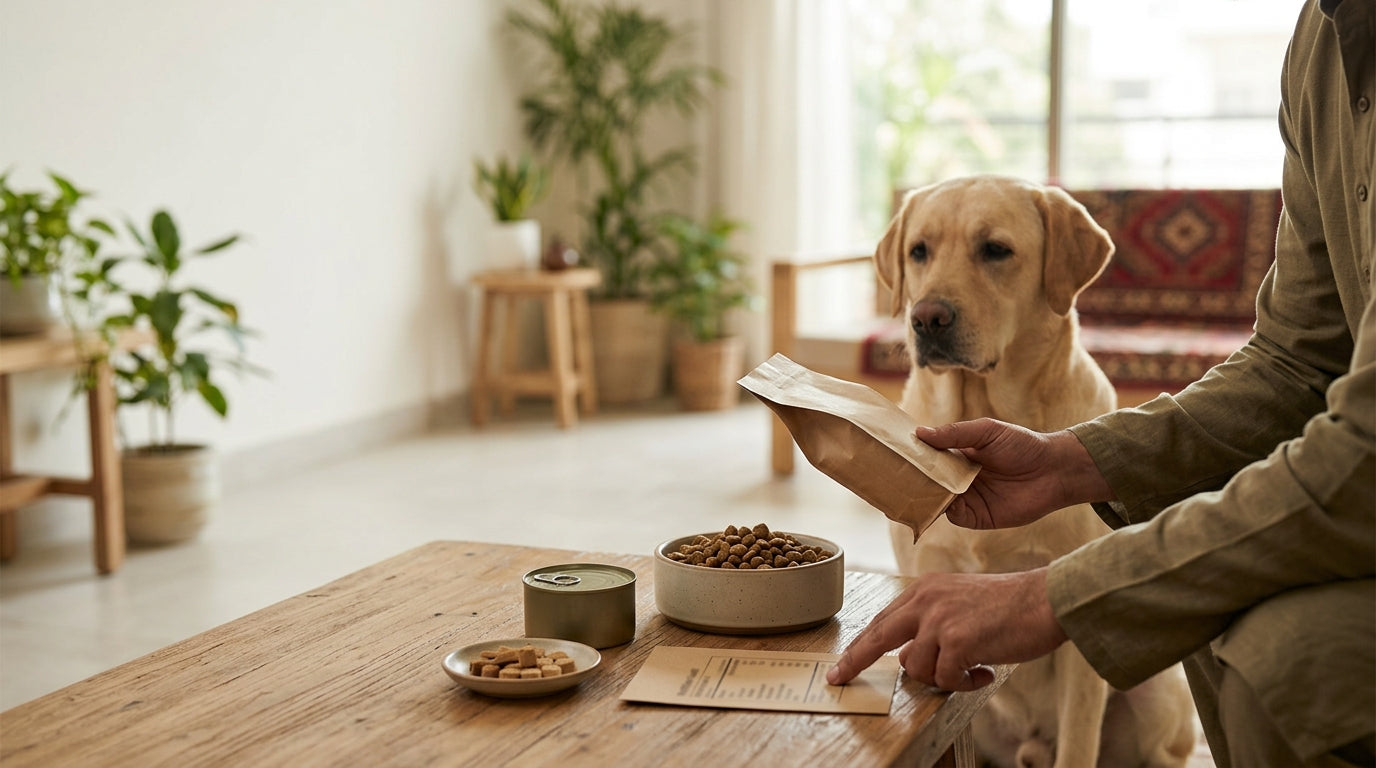
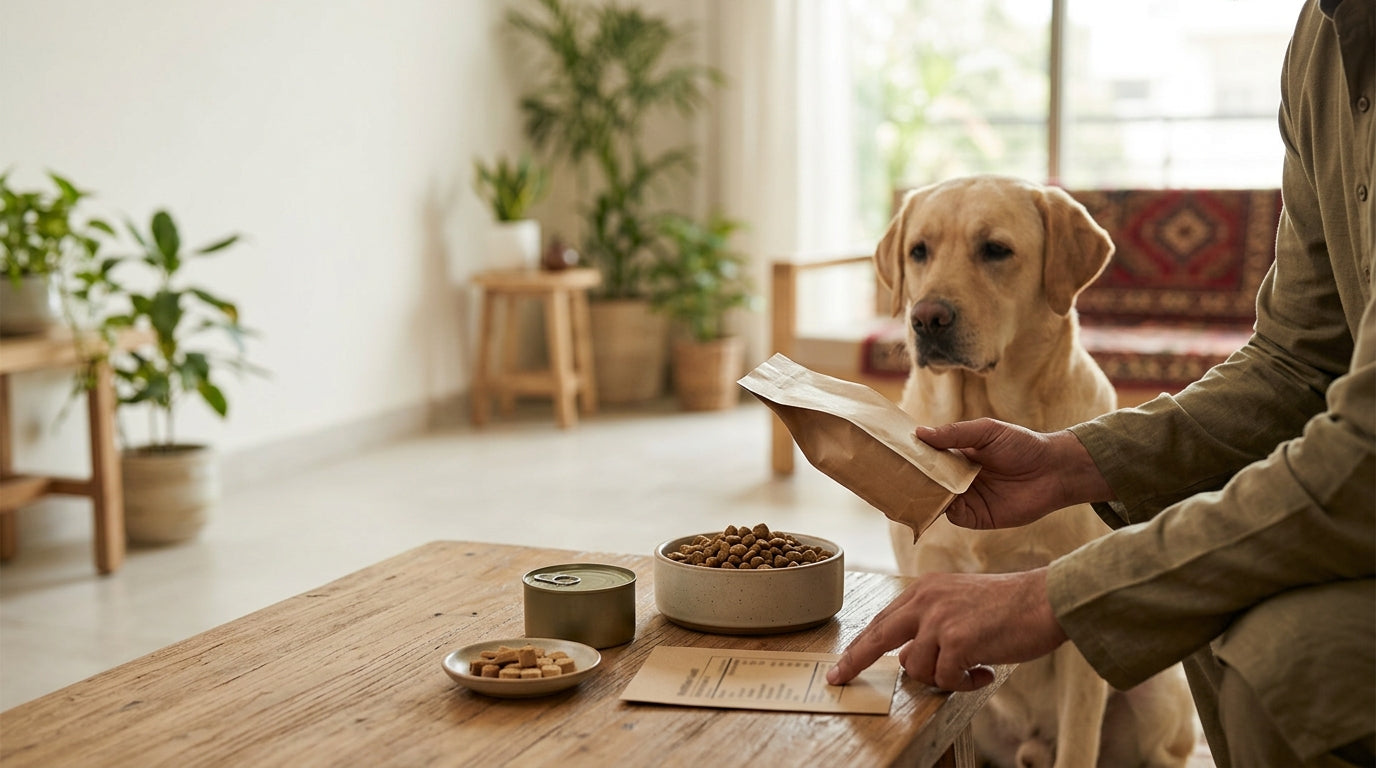
Two bags of dog food can make the same promises, premium, natural, complete, and still be very different foods. Telling them apart comes down to reading the pack properly, matching the food to your dog's age and size, and feeding and storing it well. That last part matters more than usual through a Pakistani summer. If you're choosing dog food in Pakistan, where imported and local options sit on the same shelf, the steps below work for any of them.

Disclosure
Pet Panda sells dog food and related pet products, and this article may link to relevant Pet Panda collections or products. The information is provided for general educational purposes and is not a substitute for advice, diagnosis, or treatment from a qualified veterinarian. Product availability, prices, and formulations may change over time.
Written by Stella Luis. Last updated: 6 October 2026.
Quick answers
- Find the nutritional adequacy statement first. It says whether the food is meant to be a complete diet, and for which life stage.
- An ingredient list can't show that a food is complete. It's useful, but it doesn't prove adequacy.
- Match the food to life stage and expected adult size. Large and giant-breed puppies need particular care.
- Treat the feeding chart as a starting point and adjust to your dog's body condition.
- Switch foods gradually, and store them somewhere cool and dry.
- Persistent vomiting, diarrhoea, significant itching or unexplained weight change warrant veterinary advice.
What "complete and balanced" means
A complete dog food supplies the nutrients a dog needs for its stated purpose or life stage. Balanced means they come in appropriate proportions. Any food sold as a dog's main diet should be meant to be both, and the place a pack makes that claim is the nutritional adequacy statement.
The terminology most people meet here comes from AAFCO, a US organisation that publishes model pet-food labelling guidance. It's a US framework, not a rule that every food sold in Pakistan has to follow, so some packs will carry an AAFCO-style statement and others will use a different format. AAFCO says its statement is usually on the back or side panel, often in small print. Marketing words like "premium," "natural" or "holistic" don't stand in for it.
Whichever pack you're holding, AAFCO does not approve, certify or endorse individual pet foods. A seller who calls a food "AAFCO-approved" is using a sales phrase, not describing an official status.
How adequacy is established
In AAFCO's framework, a food can support its adequacy claim in three ways:
| Pathway | In plain language |
|---|---|
| Formulated to meet nutrient profiles | The recipe is formulated to meet AAFCO's nutrient profile for a life stage. |
| Animal feeding test | The food was fed to dogs under a set protocol and judged to support them. |
| Comparable-product method | The food is similar to a product that has already passed a feeding test. |
These describe how a claim was made. They say nothing about whether the food is the best choice for your particular dog.
"Intermittent or supplemental feeding only"
Some packs carry this wording instead. It's a separate statement and not a fourth route to completeness. The product isn't intended to be the only diet.
If the pack uses a different standard, or none you can find
Labelling rules differ from country to country, so a pack may name another nutritional standard, or none at all. What you're looking for is a plain statement of which life stage the food is intended for and what standard it was formulated to meet. Where the pack is silent, ask the seller, importer or manufacturer. A brand that stands behind its food should be able to answer. When nobody can, treat the food's completeness as unconfirmed and raise it with your vet before making it your dog's everyday diet.
"All life stages" and large-breed puppies
An adequacy statement may mention growth, adult maintenance or all life stages. For a puppy who will grow very large, VCA's guidance on large and giant breeds points to one question: does the statement specifically support growth of large-size dogs? The statement itself answers that, and the wording on the front of the pack may not.
How to evaluate a dog food label

Start with the adequacy statement, then work through the rest in roughly this order:
- Adequacy statement and life stage. Complete and balanced for puppy or growth, adult maintenance, or all life stages? For a large-breed puppy, does it support growth of large-size dogs?
- Feeding directions and calories, including kcal per cup or per kg if listed.
- Guaranteed analysis.
- Ingredient list.
- Manufacturer or importer details, lot or batch number, and best-before or expiry date.
Guaranteed analysis
The panel usually gives minimum crude protein and crude fat, and maximum crude fibre and moisture. Those are limits, not exact amounts. Wet food contains far more water than dry food, so protein and fat percentages shouldn't be compared directly between the two as printed. To compare foods with different moisture levels fairly, the figures have to be converted to a dry-matter basis, which takes the water out of the calculation. The manufacturer or your vet can help if you want to do that.
Ingredient list
Ingredients are generally listed by weight, and the list does real work. It lets you see what's in the food, compare one formulation with another, and avoid anything your vet has asked you to keep out of your dog's diet. What it can't do is show that a food is nutritionally complete, or tell you how good the diet is overall. That is the adequacy statement's job.
Calories
Calorie information tells you how much energy a food provides, and one cup of two different foods can carry very different amounts. That helps when working out how much to feed and when comparing what each food costs per day. Calorie density alone doesn't make two foods nutritionally equivalent, or show that one is better overall. If the pack doesn't show kcal, the seller or manufacturer may be able to supply it.
Questions to ask a manufacturer
- WSAVA's guidance for pet owners suggests asking three things. Does the company have qualified nutrition expertise? How does it establish the nutritional information for its foods? What testing or research does it do?
Choosing by life stage and size

| Stage | What to look for | Notes |
|---|---|---|
| Puppy | Statement for growth | Expected adult size matters; see below |
| Adult | Statement for adult maintenance, or all life stages | Activity, neutering and body condition affect needs |
| Senior | No single rule applies | Choose by your dog's health and body condition; the word "senior" on a bag isn't a guarantee of suitability |
| Pregnant or nursing | A formulation intended for gestation and lactation | Choose together with your vet |
Puppies
A puppy needs a food made for growth, and an adult food with a handsome ingredient list doesn't make up for that. The Merck Veterinary Manual offers a general guide to meal frequency. It's a guide, and individual puppies vary.
| Age | Typical meals per day |
|---|---|
| 6–12 weeks | About 4 |
| 3–6 months | About 3 |
| 6–12 months | About 2 |
| Adult | 1 or 2 |
Large and giant breeds may remain on an appropriate growth diet longer because they mature later; meal frequency should still be adjusted according to the individual puppy.
Large and giant-breed puppies
Big puppies need their growth kept under control, and large-breed puppy foods are formulated with that in mind. VCA notes that large breeds may stay on an appropriate growth formula until around 18 months and giant breeds until around 24 months, with individual dogs varying. Your vet is the right person to say when to move to an adult food. In the meantime, check the nutritional adequacy statement for wording that supports growth of large-size dogs. A "large-breed puppy" label on the front of the pack is a useful hint, but it doesn't replace reading the statement. Leave supplements alone unless your vet advises them.
Adult, senior and reproductive stages
·
· Adult stage: Adults need the same label checks.
· Senior stage : For seniors, your dog's health counts for more than the word on the bag.
· Pregnant or nursing stages : Foods for pregnant or nursing dogs exist, but this is a stage where a vet's input is worth having.
Dry, wet, raw or homemade
Dry or wet food can be complete and balanced if its adequacy statement says so, and neither is automatically healthier. Most of the decision is practical.
| Dry | Wet | |
|---|---|---|
| Moisture | Lower | Higher |
| Convenience | Easy to measure and store | Comes in cans or pouches |
| Storage | Cool, dry place, original container | Unopened: cool, dry place. Opened: refrigerate or discard promptly |
| Palatability | Dogs vary | Dogs vary |
| Cost | Varies by product | Varies by product |
Homemade diets
Researchers at the University of California, Davis evaluated 200 published recipes for home-prepared diets for healthy adult dogs, drawn from 34 sources including books and websites. About 95% of those recipes lacked adequate levels of at least one essential nutrient, and more than 83% had multiple deficiencies. Only 9 of the 200 met all of AAFCO's minimum nutrient requirements. Four recipes written by board-certified veterinary nutritionists were acceptable (UC Davis summary).
The study looked at published recipes, so it doesn't show that every homemade diet is deficient. It does show that copying a recipe from a book or website isn't a dependable way to meet a dog's needs. If you want to feed a fully homemade diet long-term, ask your vet about working with a veterinary nutritionist. Recipes and supplement doses are beyond the scope of an article like this.
Source: Stockman J, Fascetti AJ, Kass PH, Larsen JA. Evaluation of recipes of home-prepared maintenance diets for dogs. Journal of the American Veterinary Medical Association. 2013;242(11):1500–1505.
Raw feeding
The US FDA has reported pathogens such as Salmonella and Listeria in raw pet food, and describes infection risk both for pets and for the people who handle the food or the animals (FDA: raw pet food). "Natural" doesn't mean safe, and it doesn't mean complete. If you're considering raw feeding, talk to your vet first. A raw-feeding protocol is outside what this article offers.
Buying dog food in Pakistan: imported and local
Imported food isn't automatically better, and local food isn't automatically worse. Origin tells you little by itself, so hold every food to the same checks. Availability can shift, and what's on the shelf this month may not be there next month.
| Check | What to look for |
|---|---|
| Adequacy information | A statement matching your dog's life stage, and the standard it refers to |
| Large puppies | Adequacy statement wording that supports growth of large-size dogs |
| Manufacturer or importer | Named, with contact details you could actually use |
| Label clarity | Analysis, ingredients and feeding directions complete, readable and consistent with each other |
| Calories | Listed, or available from the seller or manufacturer |
| Batch or lot number | Printed on the pack |
| Best-before or expiry date | Present, and comfortably beyond the time the bag will last |
| Packaging | Sealed and undamaged |
| Storage where it was sold | Not stacked in direct sun or a hot room |
Packaging checks like these can't prove a product is authentic, and they can't rule out a bad one. They do help you spot problems, and a seller who can't say who the importer is, or who gets vague about batch and expiry details, is telling you something. When you're buying from a seller you don't know, ask the manufacturer or importer before you commit to a large bag.
If your usual food becomes hard to find, avoid an emergency swap. Keep a little in reserve, and when you do have to change brands, make the switch gradually (see below). To compare labels on the foods Pet Panda stocks, you can look through its dog food options and pet food brands.
Cost and value
The price on the bag doesn't tell you what a food costs to feed. A cheaper bag isn't always cheaper per day, and a big bag only saves money if your dog finishes it while it's still fresh. A simple way to compare:
- Divide the bag price by its weight in kilograms to get the price per kg.
- Divide your dog's daily grams by 1,000 to get daily kilograms.
- Multiply the price per kg by the daily kilograms.
Example: a Rs 6,000 bag weighing 10 kg costs Rs 600 per kg. A dog eating 200 g a day eats 0.2 kg, so the estimated cost is Rs 600 × 0.2 = Rs 120 per day.
Work out each food's daily amount from its own feeding guidance, since calorie density differs from one product to the next. Then divide the bag weight by the daily amount to see how long it will last, and check that against the best-before date and the storage you have. Prices change, so repeat the sum before each purchase.
How much and how often to feed
The feeding chart on the pack is where you begin. Your dog's needs depend on age, size, activity, reproductive status, health, body condition and the food's calorie density. Feed to the chart, watch your dog for a few weeks, and adjust.
Body condition
Veterinary professionals commonly use a 1–9 body condition score, and WSAVA publishes charts for it. A dog at a healthy weight generally has:
- ribs you can feel under a modest layer of fat
- a visible waist when viewed from above
- an abdomen that tucks up when viewed from the side
If you can't feel the ribs, the waist has disappeared, the bones look very prominent, or your dog's weight changes without explanation, see your vet. The full chart is on WSAVA's Global Nutrition Guidelines page.
Treats
Treats add calories quickly. A commonly cited guideline, supported by WSAVA and Tufts veterinary nutrition material, is to keep them to no more than about 10% of your dog's daily calories, counting chews, biscuits and training rewards. If your dog eats a veterinary therapeutic diet, ask your vet which treats suit it. Pet Panda carries dog treats, and a measuring scoop or dog bowls and feeders make it easier to keep portions consistent.
How to switch dog food
Overnight swaps invite an upset stomach. A transition over roughly a week is a common approach, though some dogs need a much slower one. Check with your vet first if your dog has a health condition, is on a therapeutic diet, is a puppy, or is pregnant or nursing.
| Days | Old food | New food |
|---|---|---|
| 1–2 | 75% | 25% |
| 3–4 | 50% | 50% |
| 5–6 | 25% | 75% |
| 7 | 0% | 100% |
One example of a gradual transition, not a fixed schedule.
If stools go soft, drop back to the previous ratio for a day or two. Should vomiting, repeated diarrhoea, blood in the stool, lethargy or refusal to eat appear, stop the switch and call your vet.
Storing dog food safely

FDA storage guidance says dry pet food, and unopened canned pet food, belongs in a cool, dry place below 80°F (about 27°C), in its original container. That figure comes from the FDA, not from any Pakistani standard. In a hot summer many homes will run warmer than that, so the practical aim is the coolest, driest spot you have, away from direct sunlight and heat sources such as a stove or a sunny window.
The FDA also says to:
- Keep the food in its original packaging, which carries the lot number, best-before date and manufacturer details. You can also put the whole bag inside a clean, dry container with a tight-fitting lid.
- Refrigerate opened wet food, covered, or discard it promptly.
- Follow the manufacturer's storage instructions.
Two further habits are Pet Panda's own suggestions, not FDA requirements: wash and fully dry any storage container between bags rather than topping up old food with new, and wash bowls and scoops regularly with soap and hot water.
Foods dogs shouldn't eat
The ASPCA's list of people foods to avoid feeding your pets is the usual starting point. Amount and exposure matter, so a tiny taste doesn't automatically mean poisoning. Even so, there's no reason to test it.
| Food | Concern |
|---|---|
| Chocolate, coffee, caffeine | Contain methylxanthines; dark and baking chocolate are the most concentrated |
| Grapes and raisins | Can cause kidney damage; the toxic substance isn't certain |
| Onion, garlic, chives | Can cause gastrointestinal irritation and red blood cell damage; risk depends on the amount ingested |
| Xylitol | A sweetener in some sugar-free gum, sweets and baked goods; can cause low blood sugar and liver damage |
| Macadamia nuts | Linked to weakness, vomiting, tremors and raised temperature |
| Alcohol and raw yeast dough | Both can be dangerous |
| Salty foods | The ASPCA says large amounts can cause excessive thirst and urination, and in severe cases sodium ion poisoning |
| Fatty foods | High-fat foods can cause vomiting or diarrhoea and may contribute to pancreatitis in some pets |
| Bones | Can cause injury or obstruction; serious cases may need veterinary treatment |
In a Pakistani kitchen
A dish's name tells you less than what went into it. Onion- or garlic-heavy salans, chocolate sweets, sugar-free products that may contain xylitol, and very salty or oily leftovers can all cause trouble. Spicy food isn't automatically toxic, and it's the ingredients and quantities that decide.
If your dog has eaten something harmful
Call a veterinarian or emergency vet service straight away, with the product, packaging and approximate amount to hand. Don't wait for signs to appear.
Sensitive stomach, allergies, weight and veterinary diets
Sensitive stomach and food allergy
Vomiting, loose stools and itching have many possible causes, and food is only one of them. An article can't tell you which applies to your dog. If your vet suspects a food allergy, they may recommend a supervised elimination diet trial. Don't start one on your own, and don't assume an allergy from symptoms alone.
Weight management
Weigh your dog, check body condition, measure portions and count the treats. If your dog is overweight or underweight, your vet can set a calorie target and a plan.
Veterinary diets
Therapeutic diets for kidney, digestive, liver or urinary conditions are meant for diagnosed problems and used under veterinary guidance. Seeing one on a shop shelf doesn't mean it suits your dog.
Grain-free diets and DCM
The FDA has investigated reports of non-hereditary dilated cardiomyopathy (DCM), a heart disease, in dogs. According to the FDA's questions and answers on DCM:
- DCM is complex, and multiple factors may be involved, including genetics, underlying medical conditions and diet.
- Reported diets included both grain-free and grain-containing foods.
- Many reports involved non-soy legumes or pulses high on the ingredient list.
- The FDA has not established that these ingredients are inherently dangerous, and causation has not been established.
So a grain-free label is neither proof of risk nor proof of benefit. If your dog has a heart condition, belongs to a breed predisposed to heart disease, or you're thinking of changing diets, talk to your vet. The FDA's page is where to look for the latest information.
When to contact your veterinarian
Call your vet if your dog has:
- persistent or repeated vomiting
- repeated diarrhoea
- blood in the stool
- persistent itching or skin problems
- unexplained or rapid weight change
- ongoing refusal to eat
- lethargy
Speak to your vet before starting an elimination diet, a fully homemade diet, a therapeutic diet, or a diet for a pregnant or nursing dog. If you suspect your dog has eaten something toxic, call straight away.
Frequently asked questions
Is imported dog food better than local?
Not by default. Neither origin guarantees a good food or a bad one. Compare adequacy information, life stage, calories, manufacturer or importer details and batch and expiry information, whichever side of the shelf the food comes from.
What if the pack has no adequacy statement?
Ask the seller, importer or manufacturer which life stage the food is intended for and what standard it was formulated to meet. If you can't get a clear answer, treat the food's completeness as unconfirmed and discuss it with your vet before feeding it as your dog's main diet.
How do I compare a 2 kg bag with a 10 kg bag?
Compare price per day, not price per bag, using the sum in the cost section. A larger bag only saves money if your dog finishes it before the best-before date, and if you can store it properly in the meantime.
How should I store a bag once it's open?
Follow the same FDA guidance: keep it somewhere cool and dry, in its original packaging or with the whole bag inside a clean, dry container with a tight lid, and go by the manufacturer's storage instructions and best-before date. Opened wet food should be covered and refrigerated, or discarded promptly.
My dog won't eat the new food. What now?
Go back a step in the transition and move more slowly, since some dogs need much longer than a week. A dog that keeps refusing food altogether should be seen by a vet.
Can dogs eat rice or roti?
Plain cooked rice or roti isn't inherently toxic, but neither makes a complete diet. The trouble usually comes with what's cooked into them, such as onion, garlic, salt or oil. Vets sometimes recommend a short-term bland diet for a particular case of stomach upset, but that is individual advice, and a home-prepared bland diet isn't automatically right for every dog or suitable for the long term. Ask your vet.
Choosing with confidence
There isn't a single best dog food. The right one is complete and balanced for your dog's life stage, matches how much energy your dog actually uses, suits its size, health and tolerance, and comes from a source that can answer questions about it. A dog with a medical condition may need a veterinary diet chosen with your vet.
In practice:
- Narrow the field by life stage and expected adult size.
- Read the adequacy statement and the rest of the label.
- Compare cost per day for the foods that pass.
- Switch gradually, and watch your dog's body condition.
- Store the bag carefully, and take health questions to your vet.
When you're ready to compare what's available, Pet Panda's wider range of dog products is one place to start.
Sources & Further Reading
- AAFCO: Reading pet food labels
- WSAVA: Selecting a Pet Food (Global Nutrition Toolkit)
- WSAVA: Global Nutrition Guidelines, including body condition resources
- US FDA: Proper storage of pet food and treats
- US FDA: Get the facts: raw pet food diets can be dangerous
- US FDA: Questions and answers on non-hereditary DCM in dogs
- Merck Veterinary Manual: Feeding schedule for dogs
- VCA Hospitals: Nutritional considerations for large and giant breed dogs
- UC Davis: Homemade dog food recipes can be risky business
- ASPCA: People foods to avoid feeding your pets
- ASPCA Pro: People foods pets should never eat
- Tufts University, Cummings School of Veterinary Medicine, veterinary nutrition materials: treats and daily calories.
- JAVMA: Stockman J, Fascetti AJ, Kass PH, Larsen JA. Evaluation of recipes of home-prepared maintenance diets for dogs. 2013;242(11):1500–1505.
Corrections: support@petpanda.pk
