
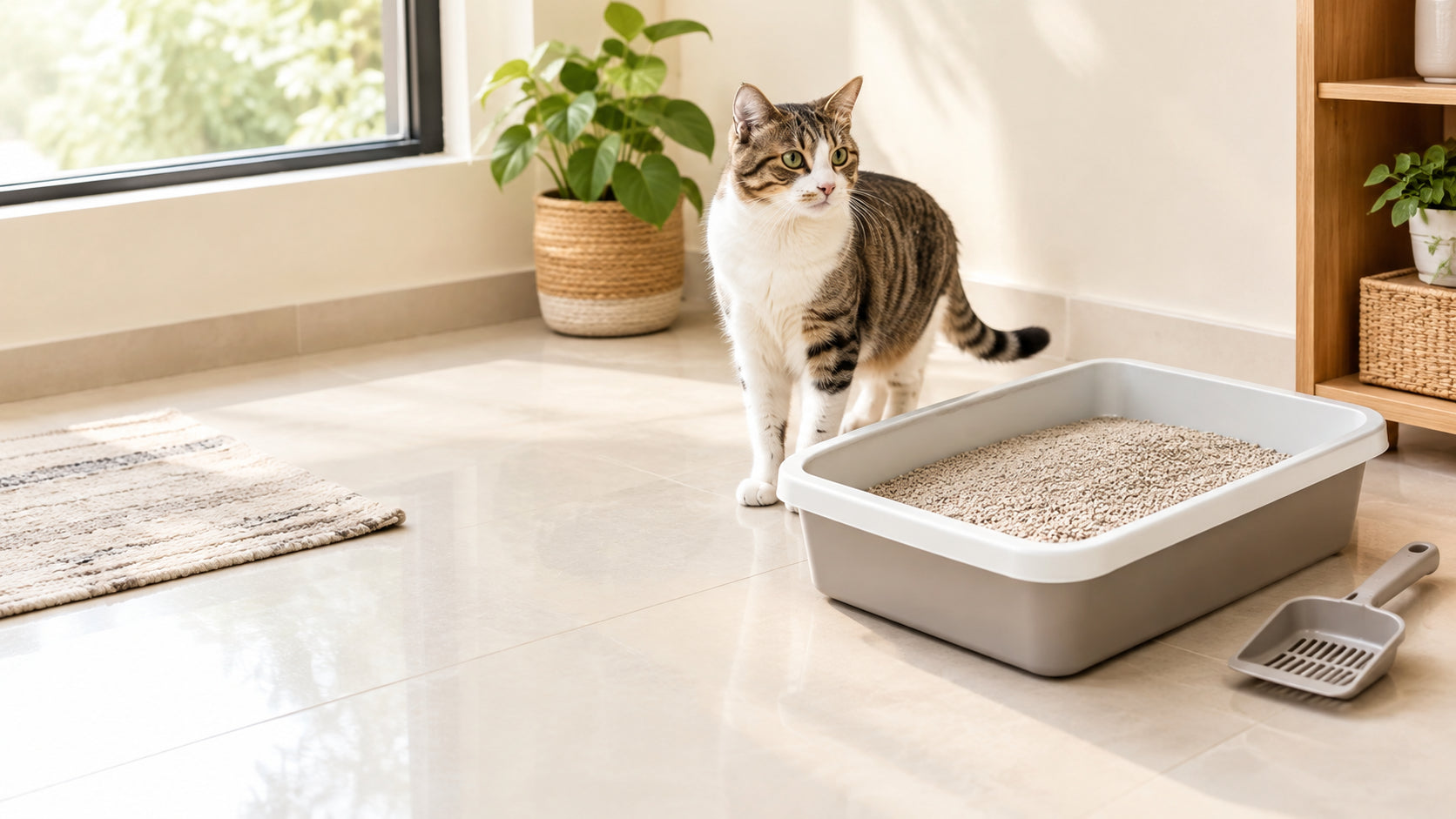
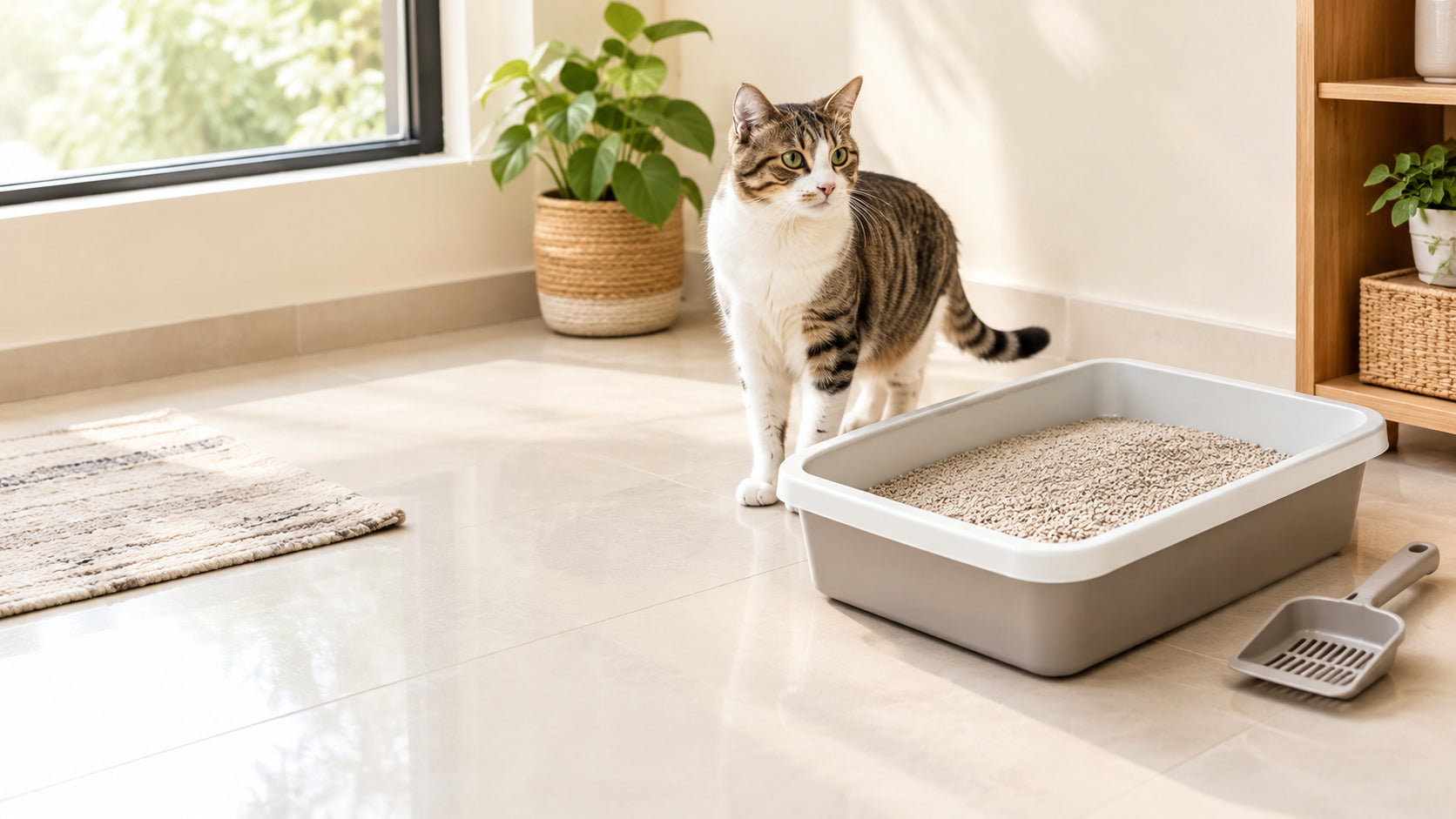
A cat will put up with a plain toy or a cheap bed. A litter tray it dislikes is another matter. It may hover at the edge, dig frantically, perch instead of stepping in, or quietly decide the carpet is a better option. Cornell's Feline Health Center says house soiling is the most common behaviour problem reported by cat owners, and that medical problems, the box, the litter and its location can all play a part.
This guide to cat litter in Pakistan covers the main litter types, how to choose one, how to set up and clean a litter tray, how to keep smells down in hot weather, and which toileting changes need a vet. This is general pet-care information, not veterinary advice, and it is not a substitute for seeing your vet. Where reputable sources give different numbers, we show the range. Where a tip is practical advice for Pakistani homes rather than something a source has tested, we say so.
Quick answer: what matters most
- Your cat's preference decides. No single litter suits every cat, so watch how your cat reacts.
- Cleanliness beats fragrance. Regular scooping and washing matter more than scent.
- Tray size, number and position matter. Aim for a roomy tray, one per cat plus one extra, in a quiet place.
- Change litter gradually. Mix the new litter in over about a week.
- Toileting changes can be medical. A cat straining to pass urine, or passing little or no urine, needs a vet immediately (see urinary warning signs).
Types of cat litter
Litters differ in what they are made of and how they behave. Differences between individual products can be as big as differences between types, so treat the table as general tendencies, not rankings. Cats Protection's litter-choosing guide is a useful starting reference.

| Type | What it is | Often-cited upsides | Trade-offs to check |
|---|---|---|---|
| Clumping bentonite (clay) | Mineral clay that forms scoopable clumps when wet | Often fine and sand-like; clumps can be removed promptly | Heavy to carry; dust varies by product; see the kitten section |
| Non-clumping clay | Clay that absorbs liquid without forming clumps | Soaks up liquid with no clumps to break apart | Usually needs fuller tray changes, because urine is harder to remove |
| Silica (crystal) | Highly absorbent crystals | Often marketed for moisture and odour control | Feels different underfoot; does not suit every cat |
| Paper | Recycled paper | Often soft and low in dust | Some cats dislike the texture if used to sand-like litter |
| Wood | Pellets or granules | Natural material; less likely to stick to paws | Hard pellets may be uncomfortable for some cats |
| Plant-based (tofu, corn) | Plant material | Often biodegradable and relatively soft | Acceptance is individual |
Clumping vs non-clumping cat litter
Cats Protection says there is no simple winner. Many clumping litters have the fine, sand-like texture cats often prefer, and clumps make it easier to remove waste promptly, but some cats dislike a particular clumping litter's dust or texture. Non-clumping litter absorbs urine into the material, so it may need replacing more often because urine is harder to remove. For kittens, Cats Protection suggests avoiding clumping litter (see the kitten section).
Which types does Pet Panda list? Only some of the types above appear in Pet Panda's current litter range. The listings we reviewed are mostly bentonite clay litters, and Billion is the only one we found that is explicitly labelled non-clumping. We did not see silica, paper, wood or plant-based litters named in the listings we reviewed, and a few listings do not say what the litter is made of. Treat those types as general background, not as products Pet Panda sells. We have no verified information on how widely they are sold elsewhere in Pakistan.
How to choose the right cat litter for your cat
Start with your cat. Cornell's vets note that most cats prefer fine-textured, unscented litter. If you are bringing home a new cat or kitten, find out what it already uses and keep to that while it settles in.
Think about scent. Cornell says most cats prefer unscented litter, and Cats Protection suggests an unscented litter with smells managed by regular cleaning. Many litters sold in Pakistan are scented. If you choose one, watch whether your cat hesitates, and scoop more often rather than adding more fragrance.
Check the dust. Dust varies between products, and a product page saying "low dust" or "dust-free" is the seller's description, not an independent test. Judge by what happens when you pour the litter. If your cat starts sneezing or coughing, mention it to your vet.
Count your cats. More cats mean a dirtier tray sooner, so a litter that is easy to scoop matters more. It also means more trays (see the setup section).
Compare the real cost. Look at how long a bag lasts in your home, not only the price. The price section shows how.
Cat litter options at Pet Panda
These descriptions come from the product pages, which we checked on 15 October 2026. They are the seller's own descriptions, not independent testing. Prices are in the price table below.
| Product | Type, as described | Pack sizes listed | Texture, scent and dust (seller's words) | Points to consider |
|---|---|---|---|---|
| Value Klumpy Cat Litter | Clumping bentonite clay | 5 kg, 20 kg and a 3-pack (3-pack weight not stated) | Described as low dust; no scent described on this listing | Clumping, so waste can be scooped out. Clumping litter is usually avoided for young kittens (see the kitten section). |
| Ultra Klumpy Cat Litter | Clumping bentonite | 5 kg and 10 kg | Formed into small round granules; described as having a gentle scent and as virtually dust-free | Clumping, so the same kitten caution applies. Watch for hesitation if your cat dislikes scent. |
| Billion Non-Clumping Cat Litter | Non-clumping; its page does not state what material it is made from | 5 kg and a 3-pack (3-pack weight not stated) | Described as virtually dust-free; no scent described on this listing | Non-clumping, so urine is absorbed rather than scooped and fuller changes may be needed more often. Material is not stated, so check before buying if that matters to you. |
How to compare these listings.
- Cat acceptance and texture: start with the litter your cat already uses, and switch gradually if you change (see switching litter).
- Fragrance sensitivity: most cats prefer unscented litter, so check whether a listing mentions scent.
- Dust and handling: "low dust" and "virtually dust-free" are seller descriptions. Pour a little and see.
- Clumping or non-clumping: clumping litter is scooped out, while non-clumping litter usually needs fuller changes more often.
- Pack size and price per kilogram: see the price table. As a practical point, larger packs are only worth buying if you can store them closed and dry.
- Kittens: Cats Protection suggests non-clumping litter while a kitten is young. None of these listings makes kitten-specific claims, so ask your vet.
Ready to choose cat litter for your home? Compare the options in Pet Panda's Cat Litter & Supplies collection and check each product's size, material, scent and current price before ordering. The collection lists many more litters, including scented bentonite options, alongside other cat supplies, so check each listing for what the litter is made of and whether it clumps. A deodorizer such as Remu Cat Litter Deodorizer is an add-on, not a litter type (see the odour section).

Cat litter prices in Pakistan
These are the prices shown on the exact Pet Panda product pages linked above when we checked on 15 October 2026, in Pakistani rupees. Prices change, so check the product page before you buy. Price per kg is the listed price divided by the pack weight.
| Product | Pack | Listed price (PKR) | Price per kg (PKR) |
|---|---|---|---|
| Value Klumpy Cat Litter | 5 kg | 350 | 350 ÷ 5 = 70 |
| Value Klumpy Cat Litter | 20 kg | 1,200 | 1,200 ÷ 20 = 60 |
| Ultra Klumpy Cat Litter | 5 kg | 500 | 500 ÷ 5 = 100 |
| Ultra Klumpy Cat Litter | 10 kg | 950 | 950 ÷ 10 = 95 |
| Billion Non-Clumping Cat Litter | 5 kg | 500 | 500 ÷ 5 = 100 |
Value Klumpy and Billion also list 3-pack options (PKR 1,000 and PKR 1,400 when we checked). The pages we reviewed do not state the 3-pack weight, so we have not worked out a per-kilogram figure for them.
Some other litters in the collection are sold by volume, for example 10-litre bags. Litres and kilograms are different measures, so don't compare them directly. Scented and unscented variants, and different ranges, can be priced differently, so check each listing.
A low price per kilo does not guarantee a low monthly cost, because how long a bag lasts depends on your cat, the litter and how often you change it. Write down the date you open a bag and the date it runs out, then divide the price by the number of days.
How to choose and position a litter tray
Good setup advice is fairly consistent across veterinary and animal-welfare sources. An illustration can't prove what your cat needs, so use the figures below as starting points and watch your cat.

Size. Battersea and RSPCA Australia both suggest a tray at least 1.5 times your cat's length, measured from nose to the base of the tail. Many commercial trays are smaller than that. Your cat should be able to stand, turn around and dig.
How many. Cornell and RSPCA Australia recommend one tray per cat plus one extra. Maddie's Fund adds that trays count as separate only if they are in different rooms, since two side by side may work as one toilet.
Where. Choose somewhere quiet and easy to reach, away from food and water and from noisy or busy spots. RSPCA Australia advises against moving trays around often. If your cat has settled on a spot you would rather not use, Cornell suggests placing a tray there first and, once it is used reliably, moving it only a few inches a day towards the spot you want, stepping back if your cat stops using it.
Open or covered. Cornell notes that most cats prefer an uncovered box, and Battersea advises avoiding covered trays where possible, though the RSPCA says some cats are happy with a covered one. If your cat hesitates at a covered tray, try taking the lid off.
Size and low sides. Cornell says larger cats need bigger boxes, and that kittens, elderly cats and cats with mobility problems need boxes with low sides.
Liners. Cornell notes that many cats dislike liners, and Maddie's Fund and Battersea advise against plastic liners.
Litter depth. Sources differ. Battersea suggests at least 3 to 4 cm and RSPCA Australia about 3 to 4 cm. Cats Protection's current guide suggests around 3 cm, while noting that individual cats have their own preferences. Cornell suggests one to two inches (about 2.5 to 5 cm), and Maddie's Fund says most cats like several inches to dig in. Pet Panda's Value Klumpy, Ultra Klumpy and Billion pages suggest about 6 cm. Start with the instructions on your litter's pack or page and adjust for your cat: deep enough to dig and bury waste, but not so deep that litter sprays out of the tray or forms an uneven surface.
How to switch to a new litter gradually
The RSPCA advises mixing a new litter in with the old gradually over about a week, or offering it in a separate tray so your cat can choose. Cats Protection suggests increasing the proportion of new litter over at least a week and also advises against swapping a familiar litter overnight. Change one thing at a time, so that if your cat objects you know what caused it.
How to scoop and clean a cat litter tray
A practical routine to start with: scoop at least once a day (twice if you can), top up with fresh litter as needed, and empty, wash and refill the tray about once a week. Shorten the interval for non-clumping litter, multi-cat homes and hot weather, and whenever the tray looks or smells dirty. Sources give slightly different ranges, shown here:
- Scooping: Remove waste at least once a day (RSPCA, Maddie's Fund, Battersea). Cats Protection says at least twice a day. Scooping more often is fine, especially in hot weather.
- Topping up: Add fresh litter as it gets used, so the depth stays consistent.
- Emptying and washing: The RSPCA, Cats Protection and Maddie's Fund suggest emptying and replacing all the litter at least once a week, and Battersea suggests washing the tray weekly with mild, unscented dish soap. Cornell says to change litter often enough that it looks and smells dry and clean, and more often the more cats use the box. Pet Panda's litter pages suggest at least every 10 days, or when needed. We suggest treating 10 days as the longest gap, not the target.
- When to clean more often: Non-clumping litter, hooded trays and multi-cat homes usually need more frequent changes (Cats Protection, Cornell).
- Drying: Rinse well and dry the tray fully before refilling.

Cleaning versus disinfecting
Cleaning removes dirt and germs with soap or detergent, while disinfecting kills germs with chemicals. The CDC says cleaning is usually enough for most pet items, with disinfecting as an extra step in some situations. It suggests that items touching poop or pee, such as a litter box, be disinfected as often as you would disinfect your toilet or bathroom, and that you clean and disinfect more often if your cat is sick or if someone in the household is more likely to get very sick from germs (the CDC lists people with weakened immune systems, children under 5, adults 65 and over, and pregnant women).
Cats Protection advises avoiding strongly scented cleaning products and using hot soapy water or a cat-safe cleaner, and Battersea advises avoiding strong-smelling cleaners and disinfectants such as bleach, because strong smells can put a cat off the tray.
A sensible middle route: wash with mild detergent on your regular schedule, and disinfect only when you need to, for example because your cat has been ill or someone in the household is more vulnerable to infection. If you disinfect:
- Keep your cat out of the area while you work, and do not let your cat touch or lick the disinfectant.
- Empty the tray and clean it first with soap or detergent and water. Some disinfectants, including bleach, need this step to work.
- Use a disinfectant exactly as its label says, including the contact time and any ventilation directions. The CDC page linked above gives step-by-step methods for hard items, including a diluted bleach method.
- Rinse well with water to remove any residue.
- Let the tray dry completely before refilling it or letting your cat use it.
Chemical safety. Never mix bleach with ammonia or other cleaners, because this can produce dangerous, toxic gases. The CDC warns that phenols are very toxic to cats, and the word "phenol" can be part of a longer ingredient name such as 2-phenylphenol, so check the ingredient list of any disinfectant you use around them. Store disinfectants out of your cat's reach. Cats Protection's behaviour article also warns that phenol disinfectants are toxic to cats, and advises following your vet's guidance if they recommend a stronger tray cleaner. If you are unsure whether a product is safe near cats, ask your vet.
Cleaning up accidents outside the tray
Clean accidents promptly. Maddie's Fund and the RSPCA suggest an enzymatic cleaner made for pet accidents, which breaks down the smell instead of covering it. Cornell adds that odours must be neutralised, not just deodorised, and advises avoiding cleaning products containing ammonia or vinegar, which smell like urine and can be irritating.
How to reduce cat litter smell in hot weather: odour, dust and hygiene
Clean first, fragrance last. A tray that is scooped promptly and washed on schedule usually smells less than a dirty one covered in perfume. For hot Pakistani homes, these ideas are practical suggestions, not tested findings:
- Scoop an extra time in summer if the tray smells by evening.
- Keep the tray in a ventilated spot out of direct sun. Heat and no airflow tend to make smells worse.
- Close opened litter bags tightly and store them dry, away from heat and damp floors.
- Be careful with sealed bathrooms and sunny balcony corners. They may seem convenient but can be uncomfortable for your cat.
- Wash your hands after scooping, and keep children away from the litter.
Cornell also advises replacing old boxes that smell or are cracked.
If you want an add-on, Pet Panda lists Remu Cat Litter Deodorizer, a 500 g baking-soda product (PKR 500 when we checked). Its page says it is moisture-activated and releases a fresh scent when your cat uses the tray, so it may not suit a cat that dislikes scent. A Cats Protection behaviour article (The Cat magazine, 2013) cautions that the strong scent of litter deodorants offers cats no benefit and may lead some to reject the tray. If you try one, add it to a single tray first and watch for hesitation. It does not replace regular cleaning.
If a tray smells strong even though you clean it well, or you notice a change in the smell of your cat's urine or stool, mention it to your vet.
Cat litter for kittens: safety and clumping litter
Cats Protection says it is usually best to avoid clumping litter for kittens. Kittens investigate unfamiliar things with their mouths, and swallowing clumping litter could potentially cause a gastrointestinal blockage. It suggests a non-clumping litter while your kitten is young, and using the litter the kitten already knows when it comes home.
We have not found a veterinary or welfare source giving a specific age at which switching becomes safe, so we are not offering one. Ask your vet when to change, and tell them if your kitten keeps tasting or eating litter. Kittens also do better with a tray that has low sides.
Pregnancy, toxoplasmosis and litter hygiene
Cats can shed the parasite Toxoplasma gondii in their faeces, usually only for a short period after they are first infected (the CDC leaflet says up to two weeks). The CDC's leaflet for cat owners says the parasite becomes infective one to five days after it is passed, which is why it advises changing the litter daily, as does the CDC's toxoplasmosis overview. The leaflet also says that owning a cat does not mean you will be infected, and that you do not need to give up your cat.
If you are pregnant, planning a pregnancy, or have a weakened immune system, the CDC says it is best to let someone else change the litter or clean the litter box. If that is not possible, wear disposable gloves, throw them away before washing your hands, and wash your hands with soap and water straight away (CDC pet supplies guidance). Anyone handling litter should wash their hands afterwards. If you are pregnant and worried, ask your doctor.
Troubleshooting: litter-box avoidance and changes in toileting
Your cat avoids the tray. Don't assume your cat is being naughty. Cornell lists medical problems, an aversion to the box, the litter or its location, and a preference for another spot, and advises a vet check to rule out medical causes. Once that is done, look at the basics: is the tray clean, big enough and in a quiet place? Has the litter changed? Are there enough trays? Is another cat blocking the way?
Signs that a cat dislikes its setup can include hesitating, perching on the edge, not digging or covering, or using the tray for urine but not stool.
Litter on the floor. Tracking is annoying but is not usually a health issue. Try a mat by the tray, a roomier tray, and not overfilling, and avoid changing a litter your cat likes just to reduce mess.
Spraying. Cornell notes that spraying is a different behaviour from ordinary house soiling and needs different tactics. If your cat sprays, talk to your vet.
Punishment. Never punish a cat for accidents. The RSPCA advises against it, Cornell warns that the anxiety punishment causes may make house soiling worse, and Maddie's Fund says punishing a cat for marking can make it more anxious.
Smell that won't go away. Review your cleaning routine first, then see the odour section above.
Urinary warning signs: when to see a vet urgently
Emergency: straining with little or no urine
If your cat keeps going to the tray, strains, and passes little or no urine, or cannot pass urine at all, go to a vet immediately. Cornell describes urethral obstruction, a blockage of the urinary tract, as a true medical emergency that needs immediate veterinary attention, and notes that male cats are at increased risk because of their anatomy. Treat the signs as urgent in any cat. Cornell warns that an obstructed cat's condition can deteriorate rapidly, and that the time from complete blockage to death may be less than 24 to 48 hours.
Do not wait to see whether it passes, and do not try to treat it yourself.
Other signs that can point to a urinary problem include painful or difficult urination, passing urine more often than usual, crying out when urinating, blood in the urine, urinating outside the tray, and frequent licking of the genital area. These can have several causes, so a vet needs to examine your cat.
Straining to poo, or can't tell which it is
PDSA, whose pet advice is written by vets and vet nurses, says to contact your vet straight away if you suspect your cat is having trouble passing poo, for example straining for longer than usual without passing much. It also says it can be hard to tell a cat struggling to wee from one struggling to poo, especially in females.
Because a blocked urinary tract is an emergency, if you are unsure which problem your cat has, call a vet urgently. Persistent straining, signs of pain, vomiting or low energy also deserve prompt veterinary advice. PDSA says laxatives should only be used on a vet's advice, so please don't give laxatives or home remedies.
Other changes
Illness can change toileting habits, and cats with medical conditions don't always act sick. A sudden change in toileting, or a cat that stops using its tray, deserves a vet visit before you assume the cause is behaviour.
How to dispose of used cat litter
How you dispose of litter depends on what it is made of, what the product label says, and your local waste arrangements. We have not found authoritative Pakistan-specific guidance on flushing, composting or municipal collection of cat litter, so we make no claims about plumbing, sewers or local waste rules. Don't assume a litter is flushable or compostable unless its label says so and your local system allows it.
As a practical suggestion, not a tested rule, scoop waste into a tightly tied bag before it goes into your normal household bin, and wash your hands afterwards.
Frequently asked questions about cat litter in Pakistan
What is the best cat litter in Pakistan?
There isn't a single best one. Choose a litter your cat accepts, check dust and scent, and compare cost over time. If you are bringing a cat home, start with whatever it already uses.
Is clumping or non-clumping litter better?
Cats Protection says there is no simple winner. Clumping litters are often fine and sand-like and make prompt scooping easier, while non-clumping litters usually need fuller changes more often. For kittens, Cats Protection suggests avoiding clumping litter, so ask your vet.
How many litter trays does a cat need?
One per cat plus one extra, in separate places around the home.
How often should I scoop and wash the litter tray?
Scoop at least once a day, and some sources say twice. Replace all the litter and wash the tray about weekly. Pet Panda's litter pages suggest at least every 10 days. Adjust for your litter type and number of cats.
Is scented litter a good choice?
Cornell says most cats prefer unscented litter. If you use scented litter, watch for hesitation, and don't use fragrance as a substitute for cleaning.
How deep should the litter be?
Most welfare guides suggest about 3 to 4 cm, Cornell suggests one to two inches (about 2.5 to 5 cm), and Pet Panda's litter pages suggest about 6 cm. Follow your litter's instructions and adjust for your cat.
Is clumping litter safe for kittens?
Cats Protection says it is usually best to avoid it for kittens, because swallowing it could potentially cause a blockage. Ask your vet about your own kitten.
How can I reduce litter smell in hot weather?
Scoop more often, keep litter dry and sealed, wash the tray on schedule, and give it airflow away from direct sun.
Why has my cat stopped using its tray?
Possible causes include illness, a dirty or small tray, a recent litter change, stress or competition with another cat. See a vet first.
Can I flush cat litter?
Don't assume so. It depends on the litter, its label and your local drainage, and we haven't verified Pakistan-specific rules.
Can pregnant women change cat litter?
The CDC says it is best for someone else to do it. If no one else can, wear disposable gloves and wash your hands straight away.
Final advice for choosing and maintaining cat litter
Pick a litter your cat accepts, give it a roomy tray in a quiet, airy place, and scoop and wash on a regular schedule. If your cat's toileting suddenly changes, treat it as a possible health issue first, and if a cat is straining and passing little or no urine, go to a vet straight away.
When you are ready to choose, compare the options in Pet Panda's Cat Litter & Supplies collection and check each product's size, material, scent and current price before ordering. If you are also choosing food for your cat, you may find Pet Panda's Complete Cat Food Guide for Pakistani Pet Owners useful.
Sources
- Cornell Feline Health Center: Feline behavior problems, house soiling
- Cornell Feline Health Center: Feline lower urinary tract disease
- Cats Protection: How to choose the best cat litter
- Cats Protection: Behaviour, to pee or not to pee (The Cat magazine, PDF)
- Battersea: How to create the best litter tray setup for your cat
- RSPCA (UK): Litter
- RSPCA Australia: Encouraging your cat to use a litter tray
- Maddie's Fund: Litter box tips
- CDC: Cleaning and disinfecting pet supplies
- CDC: About toxoplasmosis
- CDC: Toxoplasmosis, an important message for cat owners (PDF)
- PDSA: Constipation in cats
